
Impacted teeth are unerupted or partially erupted teeth that cannot fully erupt due to:
- Lack of space (crowding)
- Misalignment (tooth is rotated out of position)
- Conflicting position (another tooth has erupted over that position)
- Ankylosis – when other causes of impaction are not corrected in a timely manner, the roots of the impacted tooth can fuse to the surrounding bone creating a tooth frozen in an unerupted or partially erupted state.
The teeth most likely to become impacted are the third molars, also known as “wisdom teeth.” The first molars are also known as the 6-year molars since they generally erupt at around age 6, and the second molars are also known as the 12-year molars since they generally erupt at around age 12. If the third molars erupted normally, they might be called 18-year molars. But there is rarely enough space to fit these last teeth into the small space left behind the second molars, so the third molars often become impacted.
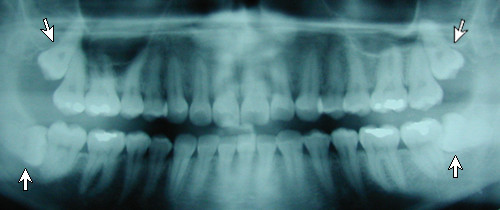
This panoramic x-ray shows the impacted 3rd molars (wisdom teeth).
The upper wisdom teeth are crowding the sinus cavity and may erode the roots of the 2nd molars. The lower wisdom teeth are impacted sideways and are likely to cause crowding of the lower teeth, leading to malocclusion.
The most important thing to know about impacted teeth is that they almost always require extraction. The longer the extraction is postponed, the longer the tooth roots grow. When the tooth roots of an impacted tooth are allowed to develop, the risk of complication due to extraction increases significantly because the tooth roots may “wrap around” sensitive facial nerves.
The risks of keeping an impacted tooth extend beyond the impacted tooth itself. Any impacted tooth will exert forces on the arch of your smile that may cause unnecessary crowding of your teeth. An impacted tooth below the gum surface may erode the roots of adjacent teeth. An impacted tooth above the gum line may create a “food trap” that is difficult to brush or floss and is likely to lead to decay.
If you have an impacted tooth and you are not FULLY aware of the risks and alternatives associated with keeping or extracting an impacted tooth, please Contact Us for an appointment.